Luxury Octagon Tent Manufacturer Guide: How to Choose a Premium Glamping Structure That Actually Performs
Not every tent that looks premium is built for a premium project. That difference matters most when a buyer is evaluating a luxury octagon tent manufacturer, because this product category is usually purchased for room inventory that has to carry a real hospitality promise. In other words, the tent is not there simply to provide shelter. It has to support brand positioning, guest comfort, operational flow, maintenance discipline, and long-term pricing power.
Why the octagon format sits above a basic safari-tent conversation
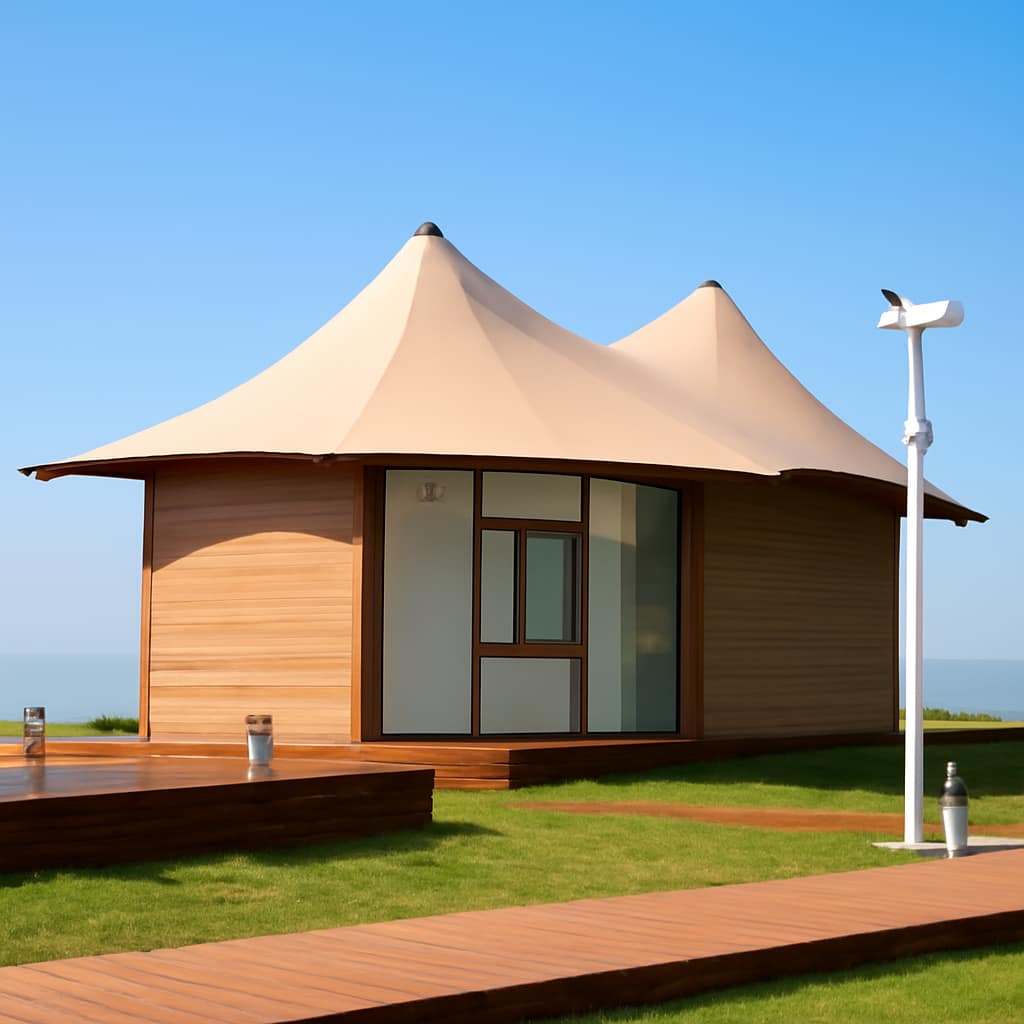
The product page positions the Luxury Octagon Tent as an upgraded version of the classic safari tent rather than as a completely separate concept. That distinction is important. A standard safari tent is already familiar to many resort developers, so the octagon model is not asking the market to learn an entirely new product language. Instead, it offers a more refined layout identity built on a proven hospitality tent idea. The result is easier for operators to understand: the model still feels recognizably suited to glamping and safari-style accommodation, but it carries a more sculptural, premium room character.
The octagonal geometry also changes how the unit is perceived before a guest even steps inside. Rectangular or straightforward safari layouts usually communicate practicality first. The eight-sided form, by contrast, creates a more intentional silhouette. From a distance it reads as a destination room rather than a standard tent box. That matters in marketing photography, in sales conversations with resort investors, and in the moment a guest arrives at the platform. If the property strategy depends on emotional first impressions, the geometry itself becomes part of the product value.
The specifications buyers should understand before they ask for a price
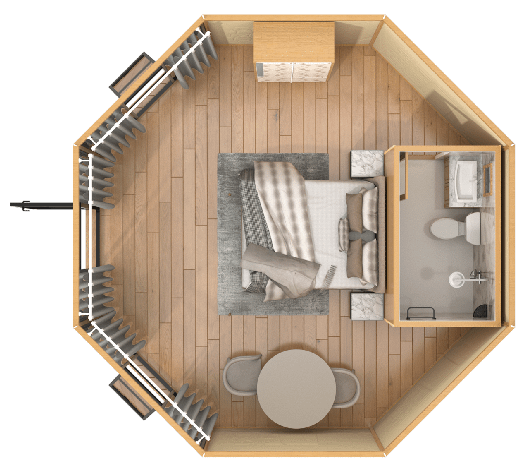
According to the product information indexed for this model, the outer footprint is 8×8 meters and the inner dimension is approximately 6 meters. That immediately tells a buyer that the value of the product is not only in floor area, but also in spatial proportion. The footprint helps with site planning and deck design, while the inner dimension indicates how the enclosed guest room may actually feel in use. Premium hospitality buyers should always separate those two concepts, because a room can occupy a large platform while still feeling visually constrained if its interior geometry is not handled well.
The page also describes the unit as a one-bedroom configuration for two guests with air conditioning. That is a useful framing device when reviewing supplier suitability. It suggests that the model is intended to operate as a genuine accommodation unit rather than a lightweight shell that still requires the buyer to solve all comfort questions independently. For a procurement team, that means the supplier conversation should include climate control strategy, power routing, privacy, glazing choices, and whether the interior package supports a guest-ready finish instead of a purely structural delivery.
Another practical detail is the way the roof form is described. The product page states that rain and snow can slide off the roof more easily, and it also presents the model as adaptable to nearly any terrain. Those are not decorative claims. For a serious buyer they translate into engineering and project-management questions: what base system is recommended on uneven sites, what anchoring logic is needed, how should decking interface with the tent envelope, and what climatic limits should be considered before the product is specified for year-round use? A useful manufacturer is one who can answer those questions clearly before a quotation becomes a purchase order.
What a strong manufacturer should be able to explain without hesitation
First, the manufacturer should be able to explain where the octagon layout genuinely adds value. A premium buyer does not need a sales speech about uniqueness for its own sake. They need to know whether the shape improves guest perception, circulation, view orientation, or layout storytelling compared with a more standard safari structure. If the supplier cannot link geometry to commercial intent, the conversation is still too generic.
Second, the supplier should be specific about add-on integration. The indexed product details mention optional glass doors, glass windows, floor systems, bathroom sets, and indoor furniture. Those options are not side notes. They are where many premium projects either gain coherence or fall into a patchwork result. A credible luxury octagon tent manufacturer should be able to talk through which accessories are factory-integrated, which require site coordination, and how each decision affects installation sequence and final guest experience.
Third, the manufacturer should discuss site adaptability in practical rather than vague terms. “Suitable for nearly any terrain” is useful only if it is translated into platform logic, drainage thinking, loading assumptions, and the relationship between the structure and the site. If your project involves a forest edge, a lakeside slope, a safari deck, or uneven ground at an eco-lodge, the supplier should explain how the tent sits on the land and what tradeoffs come with each approach.
Fourth, the manufacturer should understand hospitality operations. Premium tents fail when they are sold as beautiful shells but delivered without enough thought for housekeeping access, guest privacy, night lighting, luggage movement, wet-zone planning, and the replacement cycle for highly visible wear items. A luxury accommodation tent is a business asset. A good supplier should speak that language with confidence.
Fifth, a serious manufacturer should provide a realistic picture of lead time and what “delivery” actually means. Does the price cover the shell only, or the shell plus flooring, glazing, interior fit-out, and selected accessories? What documentation is supplied for installation? Which parts are pre-finished, and which depend on local finishing work? Buyers who skip those questions often compare quotations that are not truly comparable.
Sixth, the after-sales conversation should start before the order is placed. Buyers should ask how future matching units are handled, how replacement panels or accessories are supplied, and whether the supplier can support a phased rollout if the project grows. That is particularly important for signature products like an octagon tent, because the operator may want one hero unit first and then a second cluster only after the first season proves the concept.
Common buying mistakes in premium tent procurement
The most common mistake is treating an upgraded tent like a purely visual upgrade. Many buyers correctly notice that the octagon form looks more premium, but then evaluate suppliers almost entirely on price per unit. That usually strips out the very things that make the product commercially worthwhile: glazing quality, flooring integration, bathroom readiness, detail finishes, or installation guidance. If a project intends to use the tent as a signature room, then the correct buying question is not “Which quote is cheapest?” but “Which quote protects the premium positioning of the room once guests actually stay in it?”
Another mistake is using the same procurement brief for every product on a resort. Standard units, family units, event tents, and hero suites should not be measured by the same criteria. The Luxury Octagon Tent often makes the most sense when it is used deliberately, for example as a honeymoon suite, a marketing-facing flagship room, or a small cluster of higher-yield units. When buyers write a generic brief instead of a strategic one, they make it harder for a manufacturer to recommend the right specification and easier to receive an inaccurate quotation.
Why this product can fit T-SUN Tent especially well
Based on the product information available for this model, T-SUN Tent is not presenting the octagon structure as an isolated concept. It is framed as a premium hospitality tent that can be configured with glass doors and windows, flooring, bathroom components, and indoor furniture. That matters because it suggests the company understands the product as an accommodation package rather than only as a frame and roof conversation.
The broader T-SUN Tent portfolio also strengthens the relevance of this page. A buyer who is planning a glamping resort or safari-style property may need more than one product type across the same site: premium suites, standard accommodation tents, event structures, reception tents, or domes. Working with a supplier that already serves multiple tent categories can simplify sourcing and reduce mismatch between different built elements on the same project.